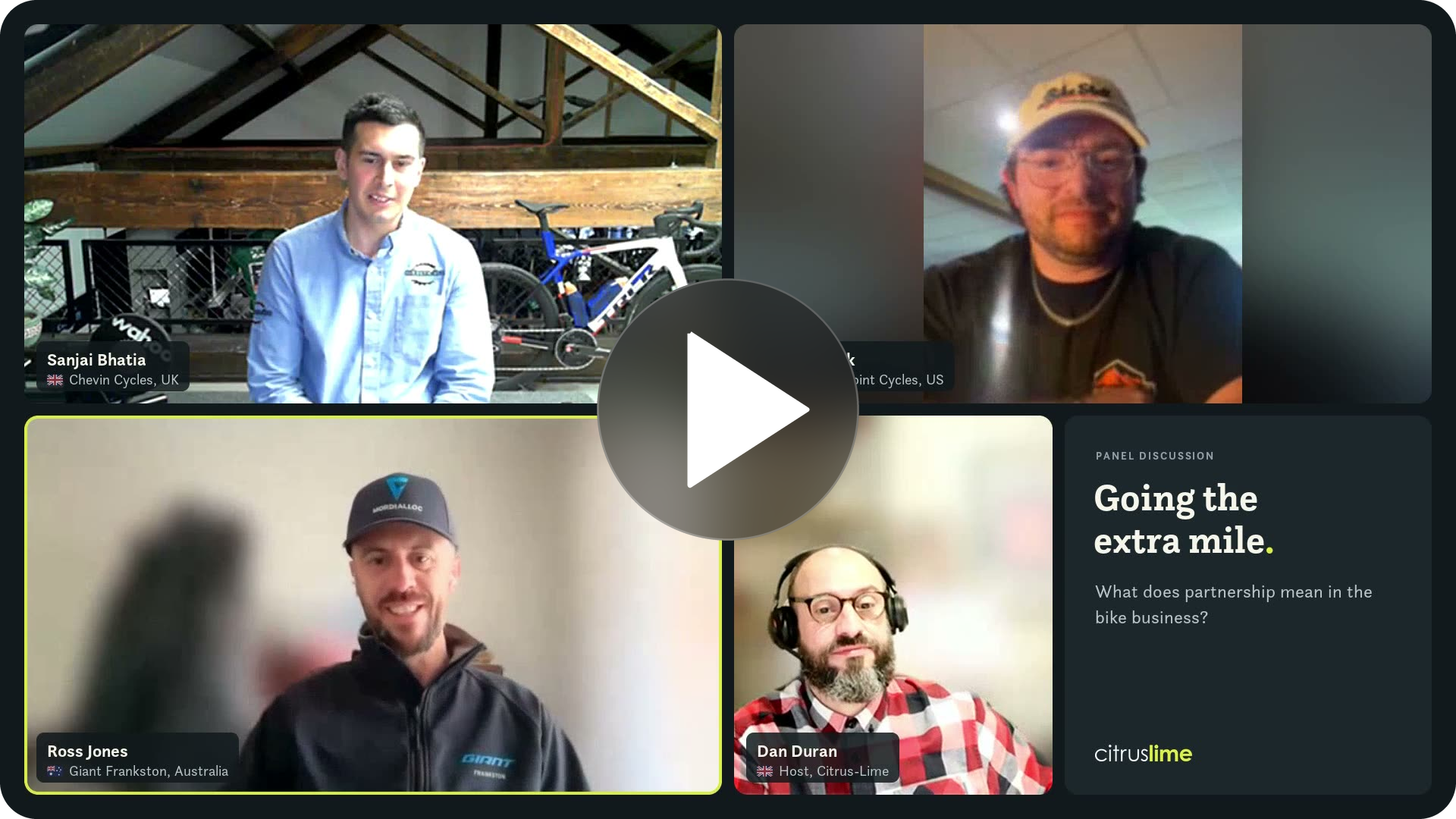
What does a bike shop just south of Melbourne have in common with a 4-store retailer operating out of New York and Pennsylvania? And what common ground can each of them find with a 2-store retailer in the north of England?
There was one way to find out, so we invited Ross Jones, owner of Giant Frankston in Australia, Anthony Folk who runs Chenango Point Cycles and Keswick Cycle in the US, and Sanjai Bhatia, director of Chevin Cycles in the UK to join us for a chat.
The conversation covered the suppliers, staff, systems and support each shop relies on, both when business is thriving, and when things go wrong.
If you have 45 minutes to sit down with a coffee there’s plenty to learn from the panel, but for those who want the key takeaways in a hurry, scroll down for the highlights…
1. A good partner does more than sell to you
The question of supplier relationships was first up. Anthony shared that ever since he started working in the industry he’s been focused on changing how his business deals with suppliers. When times are tough, he feels like it’s important to be on the same page about more than just the product lines:
“Who’s going to not just align the products that they sell with us, but whose morals and values align with ours, and do they have a good product? All three of those things kind of combine to make an ideal partner-shop relationship.”
Over at Giant Australia, Ross has built a partnership so foundational that the brand helped with the fit-out of his new store. Dealing with just one brand is a different ball game, but he’s always had the sense that someone at head office wants his shop to succeed. When the shop does well, the brand does well, and things work out for everyone.
Sanjai framed his answer around the long-term vision. When he works with suppliers, he wants to see that they’re invested and informed about his shop, his stock and his customers, for mutual benefit over years to come. He says; “It’s not about buying more stock, it’s about how they can support you to grow, and how to be a stable partner for the future.”
2. Sometimes less is more
Shops like Sanjai’s are simply choosing to work with fewer suppliers. When COVID left supply chains in tatters, retailers were forced to take stock from whoever had it, and Sanjai has spent the years since paring his list back down. His motto is ‘do more with fewer’.
Anthony feels the same way, sharing that in 2019 one bike brand made up 60 to 70% of his floor, while today he doesn’t carry a single one of its bikes:
“They make decent bikes, but it wasn’t the right partnership for us because they didn’t take the time to learn our needs, our market, and meet us in the areas where we need their support.”
Over at Giant Frankston, Ross’ experience has taught him that “suppliers can sell something to you in two seconds flat. It’s about selling you the right stuff that’s going to turn over.”
What your shop has sold in the past is the best guide as to what will sell next, and a rep willing to dig into the numbers with you is what a meaningful partnership looks like.
Sanjai summed it up well: “We’re customers of our suppliers, and we would like to be treated as we treat our customers.”
3. Reputation brings customers in, and your team brings them back
Speaking of customers, the chat quickly moved onto the question of how to keep people choosing your bike shop when there’s a myriad of other options. All three retailers were unanimous in their answers: it’s the people on the shop floor and in the service center who spend each day building those relationships.
Anthony put it like this: “It’s our reputation that gets people in the door. And it’s the fact that they feel like friends or family that gets them to come back.”
Ross added that it’s important for customers to see your team enjoying themselves. When anyone can buy the same product online, the experience of buying it from people who love what they do is what sets independent bike stores apart. He’s also careful about where sales pressure starts:
“If we as owners and managers are putting pressure on our team to sell, then that pressure comes through to the customer.”
Having the right people on your team matters. So how do you attract and retain the best talent, especially when reports say there’s a shortage of good mechanics out there?
4. Hire for personality, and keep things fun
Anthony says it’s more important to hire on personality than skillset. He’s shifted the way he hires to move away from word of mouth, and he now posts openings on professional job sites. His first filter is still the person:
“You hire somebody because you like them. They fit in the store really, really well. They get along with the staff. They’re customer focused. You can train them how to adjust a derailleur, right? How to write a work ticket.”
And once you have a great mechanic, keeping them around often comes down to the environment. Ross pointed out that flexibility matters, especially when talented staff are often being approached by other stores. When you look after your team, they’re better placed to help look after your customers.
Sanjai thinks the mechanic role itself needs a rethink. He prefers the term ‘technician’ and believes the industry has undervalued the role for far too long. As the service center becomes an increasingly profitable part of the bike business, it seems a shift is already beginning to take place.
5. A patchwork of systems slows everything down
Next, the conversation shifted to all the sides of the business a customer doesn’t see. To keep things running behind the scenes, all three retailers said a strong POS system was invaluable.
Sanjai revealed having a single solution has been a real gamechanger for his business:
“We’ve been guilty in the past of having a patchwork quilt of lots of systems bolted on together. So inefficient, it’s unreal.”
Making a switch brought better visibility for Chevin Cycles and made the customer journey far more straightforward as a result.
For Ross, one of the biggest changes since switching systems has been having customer communication in one place, with a record of what’s been said and a quick text or email sent when a job is done or stock arrives.
6. Support matters above all else
We wrapped up by asking the panel to picture their busiest Saturday, and the tool they rely on most going down. With phones, card machines and POS all running through the internet, it wasn’t too difficult for each retailer to imagine what would be at stake.
Sanjai said he’d want offline trading records, a team drilled in the playbook, and support that truly gets the situation:
“It’s about having somebody at the end of the phone or email or chat, or however you want to communicate with them, that cares and appreciates the severity of you being potentially paralyzed.”
Ross echoed the importance of having something to fall back on, so the shop isn’t flying blind for long, which is one reason every bike in his store carries a ticket with its critical information.
For Anthony, the priority is quick access to a real person, usually by phone. He couldn’t help but shout out the support he’s experienced since switching POS systems to Citrus-Lime:
“The support from Citrus-Lime is probably, if nothing else existed, the one reason that I switched. The ease of communication and the frequency at which I can communicate with somebody from the Citrus-Lime team has been… it’s been a great switch for us.”
Going the extra mile, together
Tune in to hear the whole conversation about how the right partners help you go the extra mile for your customers, or fill out the form below to find out how Citrus-Lime can help your independent bike shop.
Contact us
Normal UK & US Office Hours Mon – Fri: 8.30am to 5.30pm